OTEC:Ocean Thermal Energy Conversion
OTEC:Ocean Thermal Energy Conversion
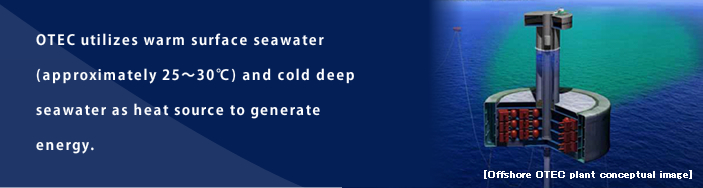
Characteristics of OTEC
- Clean and Renewable
The energy source for OTEC is naturally existing seawater, which is clean and renewable.
- Vast Potential
OTEC can be used by about 100 countries, with an estimated power generation potential around 1 trillion kW worldwide.
- Stable
OTEC can supply electricity in a stable manner throughout the year. This is a distinguishing feature of OTEC when compared to other natural energies such as wind and solar power. Affected by the weather, other natural energies can be difficult to run continuously.
- Contributing to the Reduction of CO2 Emissions
OTEC systems emit extremely low CO2 throughout its life cycle (CO2 emission rate for a 100MW-class plant is 0.014kg-Co2/kWh). In addition, C02 fixation effects are expected when diffusing the deep seawater post OTEC into the surface sea layer since marine plants grow well with the nutrient rich deep seawater.
- Other
Considering the secondary use of the deep seawater, such as fish culturing, agriculture, district cooling, production of mineral salt, production of fresh water and mineral water, and extraction of rare metal (i.e. lithium), the potential of OTEC is immeasurable.
For details, please refer to "Desalination and Secondary Use of Deep seawater.”

Power Generation Cost Comparison
| Type | Power Generation Cost (JPY/kWh) | Load factor(%) | |
|---|---|---|---|
 Ocean Thermal Energy Conversion |
1MW (Demonstration) : 40~60 10MW (Pre-commercial) : 15~25 50MW (Fully commercial) : 8~13 |
90 | |
|
Power Generation Cost (JPY/kWh) | Load factor(%) | |
|
Year 2010 | Year 2030 | |
| Nuclear | over 8.9 | over 8.9 | 70 |
| Coal-fired(The new policy scenario) | 9.5 | 10.3 | 80 |
| LNG-fired(The new policy scenario) | 10.7 | 10.9 | 80 |
| Wind(On shore) | 9.9~17.3 | 8.8~17.3 | 20 |
| Wind(Offshore; fixed-bottom) | 9.4~23.1 | 8.6~23.1 | 30 |
| Photovoltaic(Residential) | 33.4~38.3 | 9.9~20.0 | 12 |
Source:"Cost Estimation and Review Committee Report" Power generation cost (fig.36) (2004 calculation / Year 2010, 2030 Model plant) National Policy Unit, Energy and Environment Council (December 2011) |
|||

Mini-OTEC; Plant Simulator for Temperature Difference Power Generation
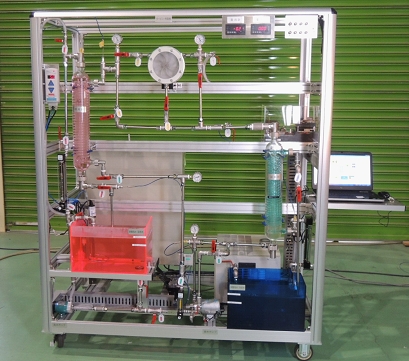
Please contact us for queries about customization to fit your needs and budget.